
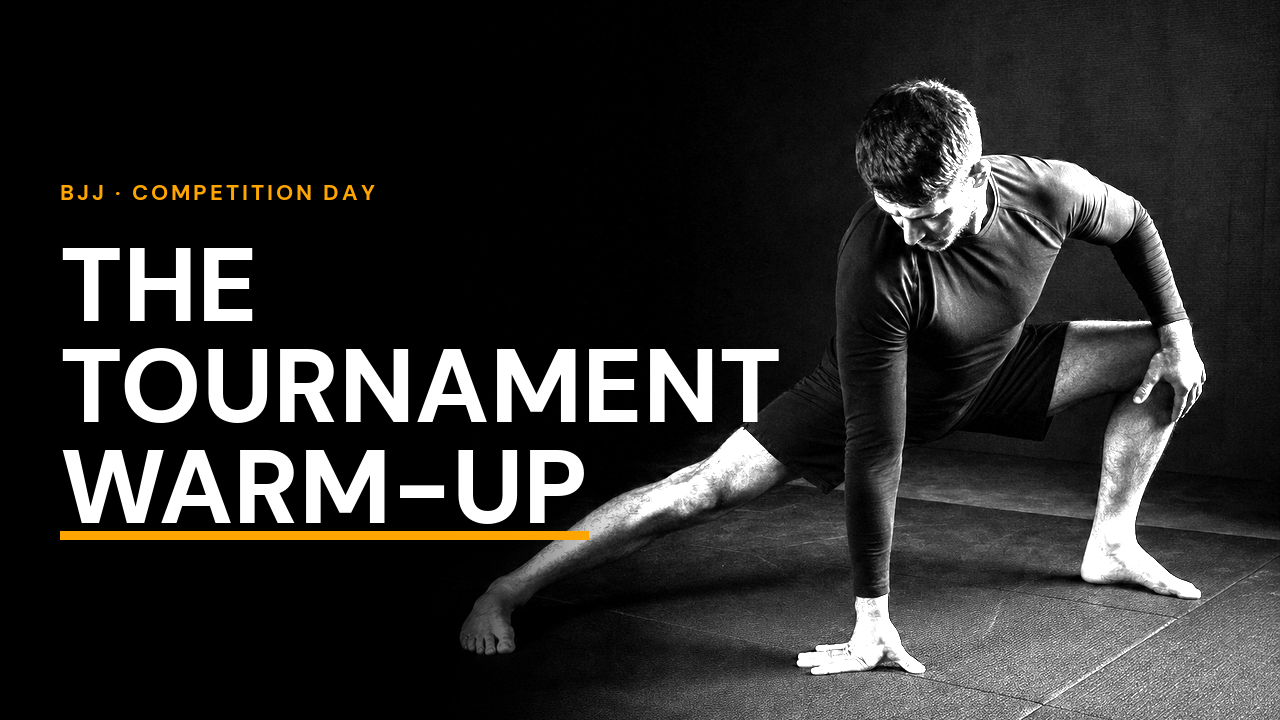
BJJ Tournament Warm-Up: What to Do With 5, 10, or 20 Minutes
Aug 31, 2024Tournament schedules do not cooperate. You show up planning a twenty-minute warm-up, matches run ahead, and suddenly your name is called with four minutes to go. Then the next round runs an hour late and you have gone cold twice. Warming up at a tournament is less about the perfect routine and more about having a routine you can compress.
This is the framework: three phases, a plan for scaling it to the time you actually have, and how to stay ready in the bullpen. It works whether you get twenty minutes or five.
Warming up for a tournament is a different job than warming up for a Tuesday class. If you are looking for a daily pre-training routine, use the pre-training warm-up instead. This page is competition day.
Why the warm-up decides your first round
Most matches that go badly go badly in the first ninety seconds. You are stiff, your timing is off, your breathing is ragged, and by the time you feel like yourself you are already down points or already tapped. A warm-up is what buys you that first ninety seconds.
- Tissue and joints: blood flow makes muscle more pliable and joints more willing to move through range. Cold tissue under a fast load is where injuries happen.
- Nervous system: a warm-up raises the rate at which you can produce force. Sharp beats sluggish, and sharpness is trainable in the five minutes before you compete.
- Mind: the routine itself flips the switch from waiting-around mode to competing mode. That is half the value.
The three phases
| Phase | Time | Purpose |
|---|---|---|
| 1. General | 5–10 min | Raise temperature, move every joint |
| 2. Specific | 5–10 min | Rehearse the positions you plan to fight |
| 3. Activation | 2–5 min | Prime the nervous system, get sharp |
Phase 1 — General (5–10 minutes)
- Three to five minutes of light jogging, jump rope, or shadow movement. Break a light sweat, do not gas yourself.
- Dynamic work through full range: leg swings front and side, arm circles, hip rotations, trunk twists, ankle circles.
- Neck through gentle range in every direction. You are about to have somebody hanging off it.
Keep everything controlled. This is not the moment to chase your best-ever split. You want mobility, not maximum stretch.
Phase 2 — Specific (5–10 minutes)
- Shadow rolling. Move through guard, side control, mount, and back control against nobody, at maybe half pace.
- Drill the entries you actually plan to use: your takedown, your guard pass, your escape from your worst position.
- Two or three reps of your A-game sequence at close to real speed, just to feel it.
If you know your opponent, bias the drilling toward the answer. Facing a strong guard player, spend the time on passing. Facing a wrestler, spend it on your stance and your reshot.
Phase 3 — Activation (2–5 minutes)
- Two or three short bursts — a 10-second sprint, a few jump squats, hard shots on a partner or the air.
- Isometric holds: 15 seconds in a low squat, 15 seconds in a hard plank, a 15-second grip squeeze on your own lapel.
- Three or four hard breaths, then settle it back down.
Short and sharp. The mistake here is treating activation like a workout — you want to feel fast, not tired. If you are breathing hard walking to the mat, you overcooked it.
Scaling it to the time you actually have
| Time available | General | Specific | Activation |
|---|---|---|---|
| 20 minutes | 5–10 min — full routine | 5–10 min — drill your A-game | 2–5 min |
| 10 minutes | 3–5 min — move every joint | 3–4 min — shadow roll only | 2 min |
| 5 minutes | 2 min — jump rope or jog | skip it | 2–3 min — bursts and holds |
When time is short, activation is the phase you protect. A body that is slightly under-warmed but neurally sharp will compete better than one that is loose and flat.
The bullpen problem: staying ready without going stale
The harder skill at a tournament is not the first warm-up. It is the second and third one, after a delay, after you have sat down, after you have cooled off. Treat every wait like a fresh clock.
- Keep a hoodie or sweats on between matches. Staying physically warm is most of the battle.
- Every ten to fifteen minutes of waiting, get up and move for sixty seconds. Do not sit for forty-five minutes and expect to be ready.
- When you get a real time estimate, restart at Phase 3 — two minutes of movement and one round of bursts.
- Between matches in the same bracket, skip Phase 1 entirely. You are already warm. Go straight to activation.
What to leave out
- Long static stretching before you compete. Holding a stretch for a minute or more can blunt force production for a while afterward. Save the long holds for after, or for a separate session.
- Anything you have never done before. Competition day is not the day to try a new mobility flow you saw that morning.
- Hard rolling in the warm-up area. You are not there to win the warm-up.
- Grip-destroying work. Save your hands. If your forearms are pumped before match one you will feel it in match three.
Where warm-ups fit in the bigger picture
A warm-up cannot fix a mobility problem, and it cannot build a gas tank. If you are stiff every session, the answer is dedicated mobility work between sessions — the mobility and flexibility video library covers it by body region. If you are dying in round two, that is conditioning, and rolling alone will not fix it.
For the training and lifting structure around all of it, read BJJ strength and conditioning: the complete guide, and use the jiu-jitsu exercise library to pick the movements.
More in this cluster: warm-up drills · the movement prep system · lower body stretches · three hip mobility drills · hip abduction work · joint health for jiu-jitsu.
Questions
Start your full routine about twenty minutes out if you have a reliable time. If the schedule is unreliable, warm up early, then keep topping up with sixty seconds of movement every ten to fifteen minutes and one activation round when you get a real call. Not long holds. Brief holds of a few seconds inside a dynamic routine are fine. Sustained static stretching immediately before competing can temporarily reduce how much force you produce. Sixty seconds of hard movement to raise your temperature, then two or three short bursts and a grip squeeze. Skip everything else and get to the mat sharp. You need about a two-foot square. Jump rope in place or run in place, then hip and shoulder circles, then squat holds and bursts. None of the framework requires open mat space. Slightly. In the gi, add grip work on your own lapel. In no-gi, add a little more neck and wrist preparation, since the exchanges tend to be faster. Both. Rest sitting down for the first few minutes if the match was hard, then get back up and stay moving. Going fully cold and fully still is the mistake. Small amounts of something you have tested before. This page is about the warm-up, but a day-long bracket is a fueling problem too, and a full stomach or a fully empty one both cost you. That is usually adrenaline, and movement fixes it faster than sitting does. Do your activation phase, breathe out longer than you breathe in for a few cycles, and go.How long before my match should I start warming up?
Should I static stretch before I compete?
What if I get called with two minutes notice?
How do I warm up when there is no space at the venue?
Is the warm-up different for gi and no-gi?
Should I warm up between matches or rest?
Do I need to eat during a long tournament day?
What if I am nervous and my legs feel heavy?
Hands that hold on when the rest of you is done.
Start with the free Grappler’s Iron Hands 14-day challenge — hands, wrists, and forearms built to keep their grip deep into a hard roll. Or step into THE PHYSICAL GRAPPLER, built around mat-specific strength, grip, and conditioning.
Start Iron Hands FreeGet THE PHYSICAL GRAPPLERGrip last. Win late.