

The Pre-Training Warm-Up for Brazilian Jiu-Jitsu
Jun 23, 2021By PJ Nestler
Brazilian jiu-jitsu is a dynamic sport. In training and in competition you use a large number of muscle groups and energy systems, and you put your body through a variety of contortions nobody else trains for. That demands a targeted, specific warm-up.
Most schools have an old-school approach: a few jumping jacks, some poorly executed calisthenics, quick static stretching, a couple of neck circles, and then everybody rolls. That is not enough preparation for what follows. Below is the purpose behind a BJJ-specific dynamic warm-up, my favorite warm-up exercises, and the pre-training routine I used with my Gracie Barra fighters.
This is the warm-up for a regular training session. Competition day is a different job with a different clock — use the BJJ tournament warm-up for that.
Step 1 — Soft tissue work (3–6 minutes)
Grab a foam roller or a lacrosse ball and spend some time preparing your muscles for the session. Self myofascial release increases blood flow and releases the tension left over from previous training.
Spend about eight to ten rolls along each major muscle group: glutes, hamstrings, calves, quads, groin, IT bands, spinal erectors, lats, pecs, and thoracic spine. Spend a little extra time on anything particularly tight or sore. A lacrosse ball targets the smaller areas a roller cannot reach.
Step 2 — Stretch what is actually tight
Now the muscles are slightly warm and the knots are worked out, so this is the moment to address flexibility. Flexibility is a real advantage in BJJ. It lets you move your body into more positions, which directly increases the techniques available to you.
It is also a major factor in staying healthy. That slight extra range of motion can be the difference between a close call and a torn hamstring. Focus on your problem areas rather than running the same generic routine everybody else does.
Region-specific work: five lower body stretches for BJJ, three hip mobility drills, and the full mobility and flexibility video library.
Step 3 — Dynamic movement
This is where the warm-up becomes specific to grappling. The goal is to take the range of motion you just created and use it under control, at increasing speed, in patterns that resemble the sport.
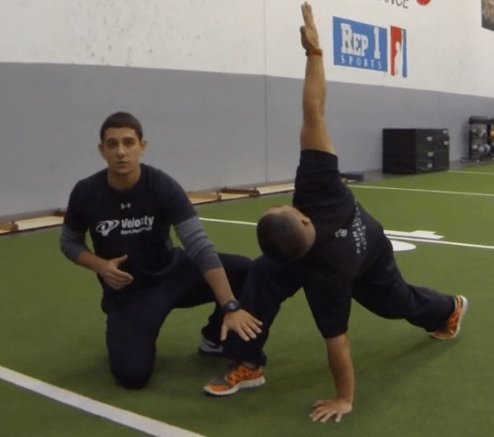
Spider lunge series — a staple of the dynamic portion.
- Spider lunge series — hips, groin, and thoracic rotation in one movement
- Inchworms into a push-up — hamstrings, shoulders, and trunk
- Leg swings front and lateral — ten each direction, each leg
- Hip bridges and bridge marches — wake up the glutes before they get loaded
- Quadruped series: fire hydrants, scorpions, hip circles, bird dogs
- Neck through gentle range in all directions
Step 4 — Activation and neural prep
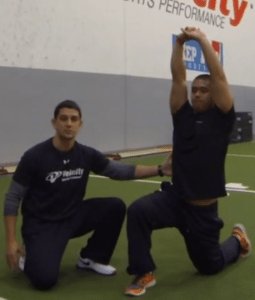
The last few minutes should be sharper. Short bursts, skipping and marching patterns, a few hard shots or sprawls. You are telling the nervous system that fast, hard work is about to happen. Keep it brief — the point is to feel sharp, not to get tired before the session starts.
The full routine, in order
| Step | What | Time |
|---|---|---|
| 1 | Foam roll and lacrosse ball, major groups | 3–6 min |
| 2 | Targeted stretching, problem areas only | 3–5 min |
| 3 | Dynamic movement and grappling patterns | 5–8 min |
| 4 | Activation and neural prep | 2–3 min |
Total: roughly fifteen minutes. If you only have five, keep step 3 and step 4 and drop the rest. Dynamic movement and activation are the parts that change how you perform in the first round.
Why this beats the traditional warm-up
- It addresses the actual restriction. Laps do not make tight hips less tight. Targeted work does.
- It prepares the joints you are about to load. Neck, shoulders, hips, and spine all take unusual stress in grappling.
- It doubles as training. Fifteen minutes of mobility work before every session adds up to hours a month of range-of-motion work you would not otherwise do.
- It leaves you fresh. A warm-up that gasses the room is a badly designed conditioning session in disguise.
For the systematic five-block version of this, read movement preparation for BJJ. For the drills a coach can run with a whole room, see BJJ warm-up drills. For the joints that keep complaining, see joint health for jiu-jitsu.
This is one piece of the warm-up picture. For competition day use the BJJ tournament warm-up, for daily range work use the mobility and flexibility video library, and for the whole training structure read BJJ strength and conditioning: the complete guide.
Questions
How long should a pre-training BJJ warm-up take?
About fifteen minutes for the full routine. A compressed five-minute version keeping only dynamic movement and activation still covers most of the benefit.
Do I really need to foam roll every session?
No. It helps most when you are sore or stiff from previous training. On a fresh day you can go straight to stretching and dynamic work.
Should I stretch before BJJ or after?
Targeted, moderate stretching before is fine once you are slightly warm. Save long static holds for after training or a separate session, since sustained holds immediately before can reduce force output.
Is this different from a competition warm-up?
Yes. Competition day is shorter, sharper, and has to survive an unpredictable schedule. Use the tournament framework for that.
What if my class already has a warm-up?
Do steps 1 and 2 before class starts, then let the class warm-up cover steps 3 and 4. Ten minutes early is all it takes.
Which part matters most for injury prevention?
Targeted mobility on your restricted areas plus glute and trunk activation. Those two address the most common failure points in grappling.
Can I use this warm-up before lifting too?
Yes, with the squat-specific and shoulder work added. The structure transfers directly.
I am short on time every session. What is the minimum?
Five minutes: spider lunges, leg swings, hip bridges, and three short bursts. That is enough to change how your first round feels.
Hands that hold on when the rest of you is done.
Start with the free Grappler’s Iron Hands 14-day challenge — hands, wrists, and forearms built to keep their grip deep into a hard roll. Or step into THE PHYSICAL GRAPPLER, built around mat-specific strength, grip, and conditioning.
Start Iron Hands FreeGet THE PHYSICAL GRAPPLERGrip last. Win late.