Safety Bar Split Squats and Hex Bar Deadlifts for Combat Athletes
Jun 24, 2021A safety bar split squat and a hex bar deadlift are two options for lower-body strength work when a conventional squat or deadlift is not the best fit. Neither is automatically safer, and neither is mandatory for combat athletes.
This article draws on William Wayland's original guest contribution. His central coaching point remains useful: select the training stress that serves the athlete instead of defending a favorite lift. The setup guidance and evidence notes below are PHYSICAL editorial additions, not new quotations or claims from Wayland.
What is a safety bar split squat?
It is a split squat performed with a safety squat bar supported across the upper back and shoulders. In the hands-assisted variation discussed by Wayland, the athlete uses a stable support to help control balance while performing the movement.
The purpose of the support is practical: balance does not have to be the main challenge when the goal is loading the legs. That does not mean the bar removes spinal loading or makes any load appropriate. The bar design, setup, range and athlete still matter.
Set up the movement before adding load
- Learn the pattern: establish a controlled split squat without a heavy bar before using this variation.
- Use a secure station: work in a suitable rack with correctly positioned safeties and stable hand support. Keep a clear way to end the set.
- Set a repeatable stance: find foot positions and a range you can control rather than copying someone else's depth or stride length.
- Keep assistance consistent: if the amount you pull on the support changes every repetition, the load is harder to interpret.
- Progress conservatively: compare your own execution over time, not the weight on the bar with another athlete's back squat.
If a painful joint position is the reason for changing exercises, do not assume the new bar solves the underlying issue. Stop movements that reproduce symptoms and seek appropriate assessment when needed.
Demonstrations from the original guest article
The original contribution included the following two demonstrations. They illustrate hands-assisted split-squat work and an advanced training example; they are not loading targets or a recommendation to copy an elite athlete's session.
Where the hex bar deadlift fits
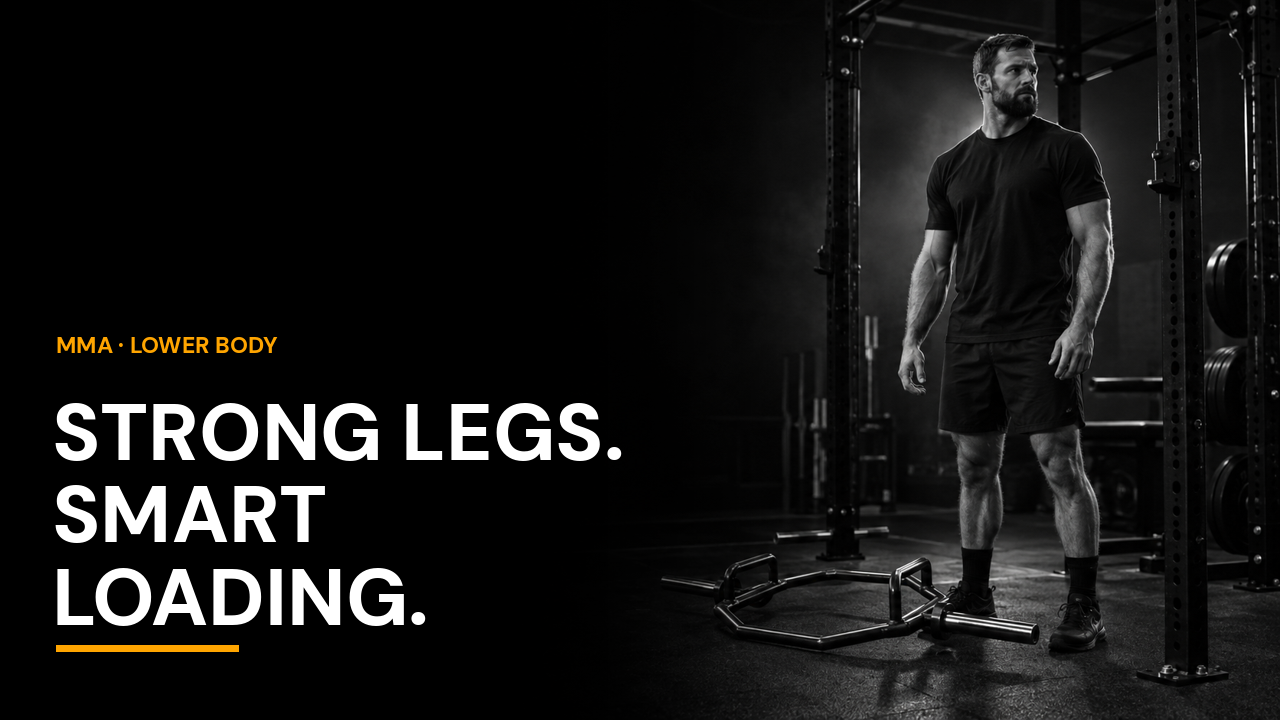
The hex bar, also called a trap bar, lets the athlete stand inside the implement with handles beside the body. It offers another way to load a lower-body strength movement when it fits the athlete and the available equipment.
In a biomechanical study of 19 male powerlifters, hex-bar and straight-bar deadlifts produced different joint moments and performance measures. The hex-bar condition had lower peak lumbar and hip moments and a higher peak knee moment. This was not an injury-rate study, and its results do not prove the hex bar is safer for every athlete.
Handle height and starting position also change the task. Record the setup alongside the weight so that a heavier number does not hide a shorter range of motion.
How to use these options in a combat-sports week
Wayland's original article described an advanced heavy-strength cycle. Those percentages should not become a general prescription for a new reader. PHYSICAL's recommendation is to start from the athlete's current ability, recovery and practice demands.
Choose a manageable lower-body emphasis for the session, use technically consistent sets, and leave room for the rest of the week. You can place a split-squat emphasis and a deadlift emphasis on different days, but you do not have to use both movements or perform both heavily.
Before adding weight, ask whether the current work is improving the intended quality without repeatedly degrading practice. More load is only one progression. Better control and a more repeatable setup may be the right next step.
Common questions
Is a safety bar split squat better than a back squat?
Not universally. It is an alternative when its setup and loading suit the athlete's goal. A well-tolerated back squat, goblet squat or other variation can remain useful.
Does hand support make the exercise cheating?
No. Support changes the exercise. Use it deliberately and consistently when balance is not the quality you intend to train.
Does a trap bar protect an injured back?
Do not make that assumption. Different mechanics are not a medical clearance or proof of lower injury risk. An athlete with symptoms needs appropriate guidance, not an automatic equipment substitution.
Original guest contribution: William Wayland, Powering Through, Chelmsford, Essex. This editorial update preserves the original exercise-selection principle and video demonstrations while separating general guidance from the original advanced programming example.
READY TO TRAIN LIKE THIS?
Put the principle into practice.
Put exercise selection into a complete training week. The PHYSICAL Fighter is a 12-week MMA strength and conditioning program built around two primary sessions per week.
Get The PHYSICAL FighterGet better, not just tired.
Coaching real people since 1998.
Related reading