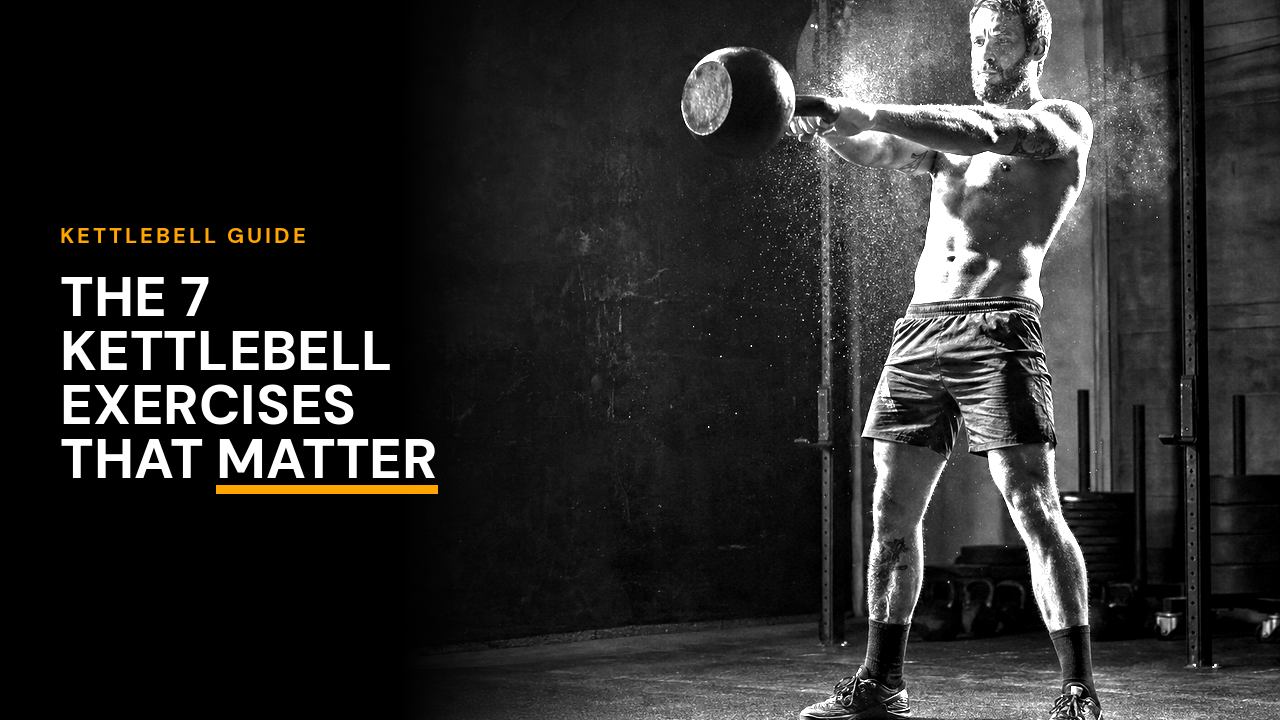
Kettlebell Exercises for Fighters and Grapplers: The 7 That Matter
Jun 23, 2021A kettlebell is a handle attached to a weight. That is the whole story. What makes it useful for a fighter or a grappler is not the shape of the iron, it is that the load hangs below your hand. You have to fight to keep it where you put it. That fight is the training.
This is the main guide. Seven movements, what each one is actually for, how to load them, and how to put them in a week without wrecking the training that matters more. If you want the version written for your sport, jump straight to it: the kettlebell workout for MMA, unconventional strength training for wrestlers, or kettlebell training for BJJ.
Why a Kettlebell Instead of a Barbell
It is not better. It is different, and the difference happens to line up with what combat athletes need.
A barbell is symmetrical and sits close to your spine. That is why you can load it heavy — it is the right tool for building raw strength. A kettlebell hangs off-center and usually sits in one hand, which means every rep is also a trunk rep. You cannot press a heavy bell overhead with a soft midsection. The bell will find the leak.
That matters in a fight because nobody grabs you symmetrically. You get loaded from one side, at a bad angle, while tired. Training one arm and one hip at a time under load is not a gimmick, it is just closer to the job. For the full picture on what the tool does and does not do, read what kettlebells actually build for athletes.

The Seven Movements
1. The Swing
The one everybody knows and most people do wrong. It is a hip snap, not a squat and not a front raise. The bell floats because your hips threw it, and your arms just steer. Done right it builds a hard hip snap and a set of lungs at the same time. Done wrong it is a lower-back grinder. Full breakdown in how to swing a kettlebell.
Sets of 10 to 20, swung with real intent. When the snap gets soft, the set is over — it does not matter what number you were counting to.
2. The Clean
Getting the bell from the floor to the rack position without banging your forearm. Most people learn this badly, then avoid every movement that needs it. The fix is to think of it as a high-pull that you tame at the top, keeping the bell close and letting your hand slide around the handle instead of yanking it.
The clean matters because it is the doorway to the press, the front squat and every complex. Learn it light and learn it early.
3. The Press
One arm overhead. The trunk has to lock down so the load has something to push against. If your ribs flare and your lower back arches, you are not pressing, you are leaning. Cut the weight.
Pressing a bell bottom-up — upside down, handle in your fist, weight above your hand — turns the volume way up on grip and shoulder control at a very light load. It is the best low-risk way to train the shoulder for grapplers. See the bottom-up kettlebell press.

4. The Front Squat
One or two bells in the rack position, squat between your legs. The load sits on your chest and pulls you forward, so your upper back and trunk get taxed as much as your legs. For anyone who gets folded over in a scramble, that is the point.
5. The Snatch
Floor to overhead in one motion. It is the most demanding thing you can do with a single bell and the fastest way to run yourself out of air. It is also the least forgiving, so do not touch it until your swing and clean are clean.
Ten minutes of snatches with switching hands will tell you more about your conditioning than any test you can buy.
6. The Turkish Get-Up
Lie down holding a bell, stand up, lie back down, never let the bell move. It is slow, it looks strange, and it exposes everything — a bad shoulder, a stiff hip, a trunk that cannot hold a position while the rest of you moves. Grapplers get the most out of this one because getting up off the floor under load is literally the sport. More in the Turkish get-up for MMA and BJJ.
Nobody needs to get-up heavy. Two or three reps a side with a bell you fully control does the job.
7. The Carry
Pick it up, walk, do not lean. The most boring movement here and probably the most useful. Carries build the grip and the trunk at the same time under long tension, which is exactly what holding position feels like. Suitcase carry one side, rack carry on the chest, overhead carry if your shoulders allow it. the banded farmer carry covers the loaded version.
Pick Your Lane
The seven movements do not change. How you stack them does. Here is where each sport should start.
| Sport | What kettlebells are best for | Start here |
|---|---|---|
| MMA | Rounds-based conditioning and one-arm pressing strength | The kettlebell workout for MMA |
| Wrestling | Grip, hip snap and awkward-object strength | Unconventional wrestling strength |
| BJJ / Grappling | Grip endurance, carries and get-ups | Kettlebell training for BJJ |
| Boxing | Hip snap into punching, plus shoulder durability | Punching power exercises |
| Training past 40 | Joint-friendly loading and single-side work | What kettlebells build |
How to Put It in a Week
Two sessions a week is enough if you also train your sport. Three is plenty. If you are trying to do five kettlebell sessions on top of hard sparring, you are going to get slower, not stronger.
Two-day template
| Day | Strength | Conditioning |
|---|---|---|
| Day 1 | Front squat 4x5, one-arm press 4x5, suitcase carry 3x40 yards | 5 rounds: 15 swings / 30s rest |
| Day 2 | Get-up 3x2 each side, bottom-up press 3x5, rack carry 3x30 yards | 10 min snatch, switch hands every 10 reps |
Three-day template
Add a third day that is only conditioning. Swings, complexes and carries with short rest, kept to 20 minutes. That is where kettlebell complexes for endurance earns its keep. Do not make the third day another strength day — you already have two.
Choosing a Bell
Most adults are fine starting with two bells. One to press and get up with, one heavier to swing and squat with. You will get further with two honest bells than with a rack of eight you never load properly.
| Bodyweight | Press / get-up bell | Swing / squat bell |
|---|---|---|
| Under 150 lb | 12–16 kg | 16–20 kg |
| 150–180 lb | 16 kg | 20–24 kg |
| 180–210 lb | 16–20 kg | 24 kg |
| Over 210 lb | 20–24 kg | 24–32 kg |
Buy cast iron with a smooth handle wide enough for two hands. Skip adjustable bells for swinging — the balance is wrong and the plates rattle.
The Mistakes That Waste Years
- Swinging like a squat. If your knees are traveling and your hips are not, you are doing a bad front raise. Push your hips back, not down.
- Going heavy on get-ups. The get-up is a diagnostic. Load it and you lose the information and gain a shoulder problem.
- Never resting. Kettlebell work turns into a puke-fest very easily, and constant gasping is not the same as building a gas tank. Rest enough to move well. why rolling alone will not fix your gas tank explains why.
- Only training one side. Everyone has a strong side. Set your reps by the weak arm and match it on the strong one.
- Skipping the carry because it is boring. It is boring. Do it anyway.
Common Questions
Can kettlebells replace weight training?
For a fighter with no gym, yes — two bells and a pull-up bar will get you strong and keep you conditioned. If you have a barbell, use both. Bells are not a better squat, they are a better carry.
How heavy should I swing?
Heavy enough that the snap is obvious and light enough that rep 15 looks like rep 1. For most trained men that is 24 to 32 kg. Weight is not the goal, hip speed is.
How many days a week?
Two if you train your sport hard, three if you are in an off-season block. More than that and you are just buying fatigue.
Do I need to learn the snatch?
No. It is the best single-bell conditioning tool there is, but the swing and the clean cover most of the same ground with less risk. Earn the snatch, do not rush it.
Are kettlebells good for training past 40?
Very. The loads are lower, the movements are single-side, and the get-up and carry build the joint control that gets lost first. Start light and keep the reps clean.
Related Reading
- the kettlebell workout for MMA
- unconventional strength training for wrestlers
- kettlebell training for BJJ
- what kettlebells actually build for athletes
- how to swing a kettlebell
- the bottom-up kettlebell press
- the Turkish get-up for MMA and BJJ
- the five pillar kettlebell exercises for combat athletes
- kettlebell complexes for endurance
For the wider programming picture, read the MMA strength and conditioning guide, the wrestling strength and conditioning guide or the BJJ strength and conditioning guide.
Seven movements will get you strong. Knowing when to swing heavy, when to back off, and how it fits around sparring is what actually moves the needle. Start with the free plan for your sport.