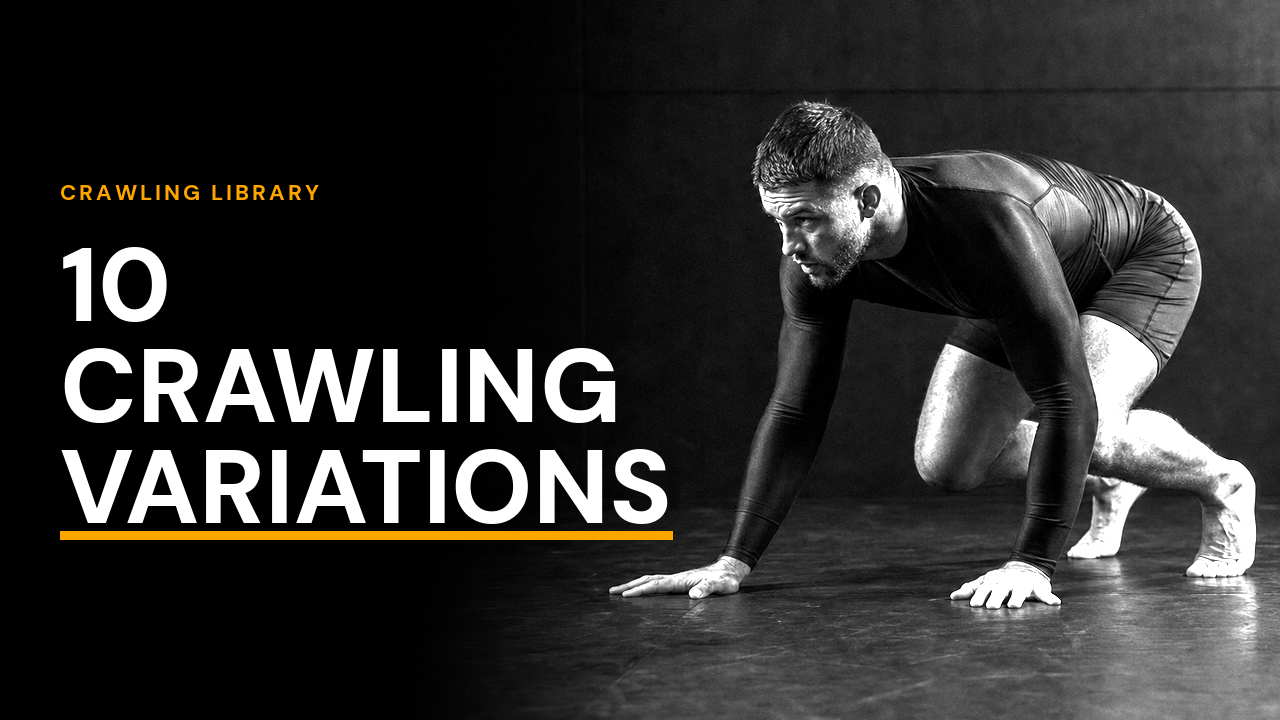
Crawling Exercises for BJJ: 10 Variations and How to Program Them
Jun 21, 2021Crawling looks like a warm-up drill, so most grapplers treat it like one. Two minutes of bear crawls, a bit of a sweat, then on to the real session. That is why it never does anything for them.
Crawling is a loaded position drill. You are holding a braced trunk, keeping your shoulders under load, and moving your hips and hands independently while something is trying to make you collapse. That is not a warm-up. That is the exact job description of top position in grappling.
This is the full library: the variations that matter, what each one actually trains, how to do them without wrecking your wrists, and how to fit them into a week that already has hard mat time in it. It sits under the BJJ strength and conditioning guide and alongside the jiu-jitsu movement library.
Why Crawling Transfers to Grappling
Three reasons, and none of them are complicated.
1. It loads the shoulder in the position you actually use it
In a crawl your shoulder is supporting bodyweight while the arm moves. That is the same demand as posting, framing, and holding someone down. Pressing overhead does not train that. Holding a plank does not train the moving part.
2. It forces contralateral connection
Opposite hand, opposite foot. Your trunk has to transfer force diagonally across the body, which is how every takedown, every bridge and every hip escape works. Crawl badly and you will feel exactly where that chain is broken.
3. It builds trunk endurance under a real position, not a held one
A plank teaches you to brace and hold still. Grappling never lets you hold still. Crawling teaches you to keep the brace while the limbs move, which is the version you need.
Do You Actually Need This? A 60-Second Test
Get on your hands and feet, knees an inch off the floor. Hold. Do not move.
| What happens | What it means | Where to start |
|---|---|---|
| Shoulders burn out under 30 seconds | No support endurance. Very common in guard players who rarely play top. | Start at the hold. Do not crawl yet. |
| Hips rise up toward a pike | You are cheating the brace by making it a stretch. | Baby crawl only, hips low, until it stops happening. |
| Lower back arches and dips | Trunk is not holding. This is the one that leads to a sore back. | Baby crawl with a slow tempo. Quality over distance. |
| Wrists scream before anything else | Wrist tolerance, not strength. Normal for anyone who has not loaded hands in years. | Fists or parallettes. Build the wrists separately. |
| Easy for 60 seconds, nothing burns | You have the base. Go straight to loaded and lateral work. | Lateral crawls and carries. |
Whatever failed first is what you train. Most people skip this test, pick the hardest-looking variation, do it badly, and conclude crawling does not work.
The Crawling Library
Ordered easiest to hardest. Do not skip ahead. Every variation below assumes hips stay low, spine stays neutral, and you move slowly enough that nobody could tell you were tired.
| Variation | Primary job | When to use it |
|---|---|---|
| Baby crawl (hands and knees) | Teaches the brace and the diagonal pattern | Week one, always. Also a warm-up for the rest. |
| Bear crawl forward | Shoulder support endurance + trunk | The default. Most bang for the time. |
| Bear crawl backward | Same, plus triceps and shoulder in a longer lever | When forward gets easy. Harder than it looks. |
| Lateral crawl | Hip abduction under load, frontal plane trunk | The one most grapplers are worst at. |
| Crab walk | Posterior shoulder, hip extension, front-body opener | Balances all the forward-facing work. |
| Leopard crawl (knees wide, low) | Deep hip position under load | Guard passing and hip mobility under tension. |
| Crawl with pause and reach | Single-arm support, anti-rotation | Direct transfer to posting and framing. |
| Crawl to hip escape | Links the crawl to a mat skill | Late in a block, when the pattern is clean. |
| Weighted crawl (plate or band) | Adds load to a pattern you already own | Only after 60 seconds clean, unloaded. |
| Crawl on fists or parallettes | Removes wrist extension demand | If wrists are the limiter, not strength. |
Baby crawl
Hands under shoulders, knees under hips, knees one inch off the floor. Move opposite hand and opposite knee together. Small steps. Hips do not rise, hips do not sway. Thirty seconds is plenty the first week.
Bear crawl, forward
Same shape, knees off the floor, feet driving. The mistake is speed. If your hips are bouncing you are running on your hands, not crawling. Slow it down until the bounce stops, then keep that pace.
Bear crawl, backward
Harder. The shoulder is loaded further from the body and the triceps do more. Go shorter distances and expect it to humble you the first few sessions.
Lateral crawl
Move sideways: lead hand and lead foot out, trail hand and trail foot follow. No crossing over. Your hips will want to rise and your trunk will want to twist. Do not let either happen. This is the variation almost every grappler is worst at — full breakdown here.
Crab walk
Sit down, hands behind you, hips up, walk. This is the counterweight to everything else, because the rest of the library is front-facing and grappling already rounds you forward. Keep the hips high; a sagging crab is just a hard seat.
Leopard crawl
Bear crawl with the knees tracking wide and the chest low. Deep hip flexion under load. This is the closest thing in the library to a passing position, and it will tell you very quickly whether your hips are actually mobile or just flexible when unloaded.
Crawl with pause and reach
Crawl three steps, stop, reach one hand forward and hold two seconds, return, continue. Everything is now on three points and your trunk has to stop you rotating. This is the most direct transfer to posting when someone is trying to turn you.
Crawl to hip escape
Crawl forward four steps, drop to your back, hip escape twice, return to the crawl. Connects the drill to a thing you do on the mat. Use it late in a block once the crawl itself is clean.
Weighted crawl
A light plate on the upper back, or a band around the hips with a partner holding tension. Load is the last variable you add, not the first. Sixty clean seconds unloaded is the entry fee.
Fists and parallettes
If wrist pain stops you before anything else fatigues, take the wrist out of it. Crawl on fists on a mat, or use parallettes. Then train wrist tolerance on its own time.
How to Program It Without Adding a Session
Crawling is cheap. It does not need its own day and it should not get one. Three places it fits:
- Warm-up, 2–3 minutes. Baby crawl and one other variation. Purpose is to wake the pattern up, not to fatigue you before you train.
- Between strength sets, 30–40 seconds. Fill the rest instead of standing around. Costs you nothing and adds up fast.
- Finisher block, 6–8 minutes. Two or three variations, work to rest about 1:1. This is where it becomes real trunk endurance work.
| Level | Frequency | Session dose | Progress by |
|---|---|---|---|
| New to it | 3×/week | 3×20–30s, baby crawl only | Adding 10s per week |
| Base built | 3×/week | 4×40s, two variations | Adding variations, not load |
| Solid | 2–3×/week | 6–8 min finisher, three variations | Lateral work, pauses, then load |
| Advanced | 2×/week | Loaded and lateral, 8 min | Load, or drop it and train something you lack |
Five Mistakes That Make Crawling Useless
- Going fast. Speed lets momentum do the work and takes the trunk out of it. Slow is the point.
- Hips too high. A piked crawl is a stretch. Keep the hips at shoulder height or below.
- Only crawling forward. Forward is the easiest direction and the one you least need. Lateral and backward is where the gap is.
- Adding load before earning the pattern. Loading a broken crawl just makes it a faster route to a sore back.
- Treating it as conditioning. It will make you breathe hard. That does not make it a gas tank builder. Different job.
Where This Sits for Your Sport
Crawling is general work, so it belongs in every combat sport, but the reason changes:
- BJJ and grappling — holding top position and keeping pressure. See the BJJ strength and conditioning guide.
- Wrestling — level changes, scrambles, and the trunk that survives them. See the wrestling strength and conditioning guide.
- MMA — the same, plus posting while getting hit. See the MMA strength and conditioning guide.
- Fighters specifically — where crawling fits in a fighter’s week.
- General strength work — crawling patterns for general strength work.
For the physiology behind it, what crawling actually builds for wrestlers and grapplers.
Common Questions
How long should I crawl for?
Thirty to forty seconds per set is plenty. Crawling is a quality drill. Once form breaks the set is over, whether that is at 20 seconds or 90.
Is bear crawling bad for your wrists?
Not inherently, but it demands wrist extension under load and most adults have none. If your wrists are the limiter, crawl on fists or parallettes and train wrist tolerance separately rather than pushing through it.
Can crawling replace core work?
It replaces most held core work, yes. A crawl asks you to brace while the limbs move, which is the harder and more useful version of what a plank trains.
How soon will I notice it in rolling?
Three to four weeks of consistent work, and the first thing you notice is usually that holding top position stops feeling like a fight to stay there.
Should I crawl on hard floor or mat?
Mat if your wrists or knees complain, hard floor otherwise. Hard floor gives better feedback because you cannot sink into it and cheat the position.
Related Reading
- what crawling actually builds for wrestlers and grapplers
- the lateral crawl, step by step
- where crawling fits in a fighter’s week
- crawling patterns for general strength work
Crawling builds the shoulders, trunk and hips that hold a position. It does not build the grip or the gas tank. Those need their own work.
Get the free Iron Hands grip and carry plan See The PHYSICAL GRAPPLER