
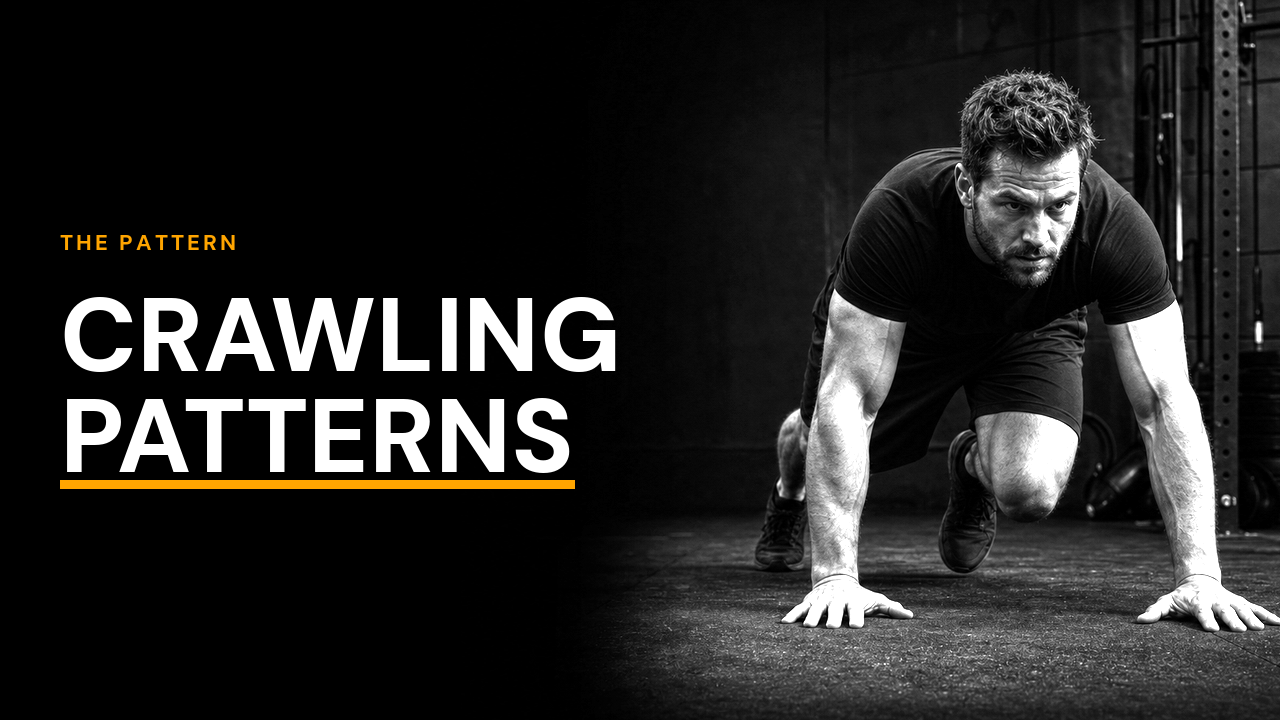
Crawling Patterns: What They Train and Who Should Use Them
Mar 17, 2023Crawling turns up in warm-ups everywhere and almost nobody can say what it is for. It is not a mobility drill, it is not conditioning, and it is not core work in the way most people mean.
It is loaded position work. You hold a braced trunk and support bodyweight on your hands while the limbs move. That is the whole thing, and it is more useful than it sounds.
What the Pattern Actually Trains
- Shoulder support endurance — holding load underneath you, not pressing it away.
- Trunk stiffness while moving — the harder version of what a plank trains.
- Diagonal force transfer — opposite hand, opposite foot, across the trunk.
- Wrist and hand load tolerance — a quality most adults have lost entirely.
- Hip control sideways — but only if you crawl sideways.
Who It Helps Most
| Who | Why it is worth their time |
|---|---|
| Desk workers | Loading the hands and holding a braced trunk is the direct opposite of sitting. |
| Anyone over 40 | Wrist and shoulder load tolerance is a use-it-or-lose-it quality, and this is a cheap way to keep it. |
| Combat athletes | Holding position is the job. See the sport-specific guides below. |
| Anyone coming back from a layoff | It is bodyweight, self-limiting, and gives instant feedback on what is missing. |
| People whose planks got boring | Same quality, more demand, less tedium. |
How to Add It Without Overhauling Anything
- Warm-up: two minutes, baby crawl then forward bear crawl. Slow.
- Fill your rest periods: 30 seconds between strength sets instead of standing around.
- Once forward is easy: add sideways. It will not be easy.
- That is it. This is not a program, it is a habit that costs three minutes.
If You Train a Combat Sport
The pattern is the same but the reason and the dosing change. Full detail here:
- the crawling exercise library — the complete variation library and programming
- what crawling actually builds for wrestlers and grapplers — the physiology, and the overselling to ignore
- where crawling fits in a fighter’s week — where it fits in a fight week
- the lateral crawl, step by step — the sideways version, which is the one people skip
Broader context in the BJJ strength and conditioning guide and the jiu-jitsu movement library.
The Five Variations Worth Knowing
| Variation | What it asks for | Start here if |
|---|---|---|
| Baby crawl (knees an inch up) | The brace and the diagonal pattern | You are new to it. Everyone starts here. |
| Bear crawl forward | Shoulder support endurance | Baby crawl is easy for 40 seconds |
| Bear crawl backward | Longer shoulder lever, more triceps | Forward feels comfortable |
| Lateral crawl | Hip abduction, trunk resisting twist | You want the version people skip |
| Crab walk | Back of the shoulder, hip extension, front-body opener | You sit a lot, or you crawl a lot forward |
The Two Rules That Decide Whether It Works
- Hips stay low. Shoulder height or below. The second the hips pike up you have turned a brace into a stretch and the drill stops working.
- Slow enough that nobody could tell you were tired. Speed lets momentum carry the load. Every useful thing about crawling lives in the slow version.
That is genuinely the whole technique. Everything else is a variation on those two rules.
How Long Before You Notice Anything
Three to four weeks at two or three sessions a week. What changes first is usually unglamorous: holding a position on the floor stops being the thing that fails, and loading your hands stops feeling like an event. That is load tolerance arriving.
Common Questions
How often should I crawl?
Two or three times a week, a few minutes each time. It is a habit, not a program.
My wrists hurt when I crawl. Now what?
Crawl on your fists or on parallettes so the wrist is not extended, and build wrist tolerance separately. Do not push through it.
Is crawling good cardio?
It will make you breathe hard, which is not the same as building an engine. Treat it as position work and train cardio separately.
Related Reading
- the crawling exercise library
- what crawling actually builds for wrestlers and grapplers
- where crawling fits in a fighter’s week
- the lateral crawl, step by step
If you train a grappling sport, the pattern is worth keeping and the rest of your week is worth a plan.
Get the free Iron Hands grip and carry plan See The PHYSICAL GRAPPLER